Tam Lin as Music and Recording
While most of this site approaches Tam Lin as a faerie story, it is also a ballad, and has as much of a musical history as a folklore history
- Musical Notation
- For 39A (3 versions)
- For 39D (1 version)
- For Lord Robinson's Only Child (1 version)
- Janet of Carterhaugh (1 version)
- Notes on the music
- Recordings Available - listings of known records of Tam Lin
- Ballad Videos - videos of performances of the ballad
Note: The Ballad of Tam Lin has associated music, listed below. There is also a well-known and lively reel called Tam Lin, less directly related to the story. It is sometimes also called Howling Wind or Glasgow Reel. If you are looking at piece of music that is lively and clocks in at under two minutes, it's much more likely to be a version of the reel, whereas the ballad tends to take a good deal longer to perform, and varies in liveliness from quite melodic to fast folk rock. Several artists have incorporated the reel into recorded versions of Tam Lin, but that seems to be a later union than an indication of common origin.
Musical Notation for Version 39A
- O I forbid you, maidens a',
That wear gowd on your hair,
To come or gae by Carterhaugh,
For young Tam Lin is there. - There's nane that gaes by Carterhaugh
But they leave him a wad,
Either their rings, or green mantles,
Or else their maidenhead.
39A, opening verses
Scots Musical Museum

source: Scots Musical Museum by James Johnson, musical illustration by William Stenhouse.
The Traditional Tunes of the Child Ballads
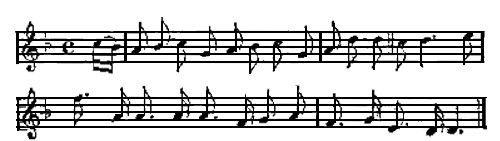
The Traditional Tunes of the Child Ballads by Bertrand Harris Bronson also includes musical notation for this version of the ballad. While Bronson's text cites Scots Musical Museum as the source for his version, the two books have slightly different notations.
Moonwise
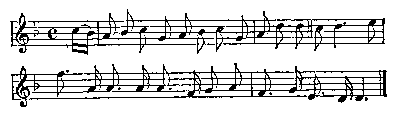
A third version of the musical notation for this version comes from the web site www.moonwise.com, whose webmistress, Tani, says that the ballad comes from a text used in a music class but the original source is unknown.
Musical Notation for Version 39D
- O all you ladies young and gay,
Who are so sweet and fair,
Do not go into Chaster's wood,
For Tomlin will be there. - Fair Margret sat in her bonny bower,
Sewing her silken seam,
And wished to be in Chaster's wood,
Among the leaves so green.
39D, opening verses
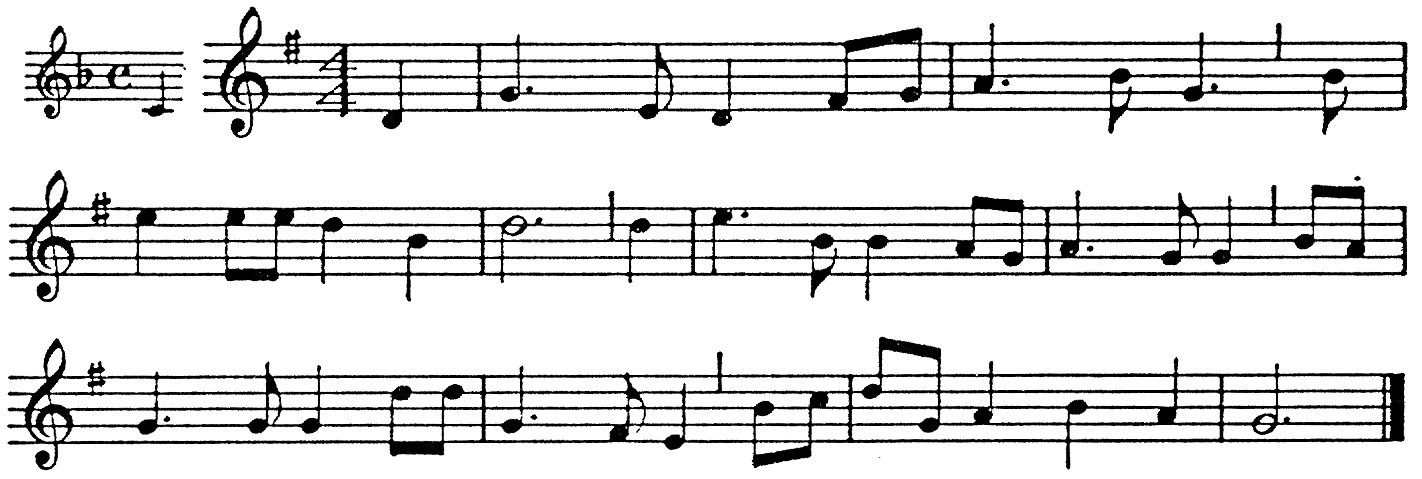
source:The Traditional Tunes of the Child Ballads by Bertrand Harris Bronson. Bronson cites:
Scarborough, 1937, p. 422; text, pp.251-54.
Sung by Margaret Widdemer, c.1932; the first stanze learned from Elinor Wylie, who learned it from her nurse, a woman "from the northern marshes.' The text as a whole appears to be refashioned, perhaps in good part on Child's D.
Musical Notation for Lord Robinson's Only Child
- As I went out one evening down by my father's lawn
A gentleman came up to me; these words to me did say:
"What makes you pull those branches? what makes you pull those boughs?
What makes you walk through these green fields without leave of me?" - "I have leave from my mother and from my father too.
Why can't I walk through these green fields without the leave of you?
And now, sir, as you prevent me, pray tell me what's your name?
That when I see my father I may tell him the same."
Lord Robinson's Only Child, opening verses
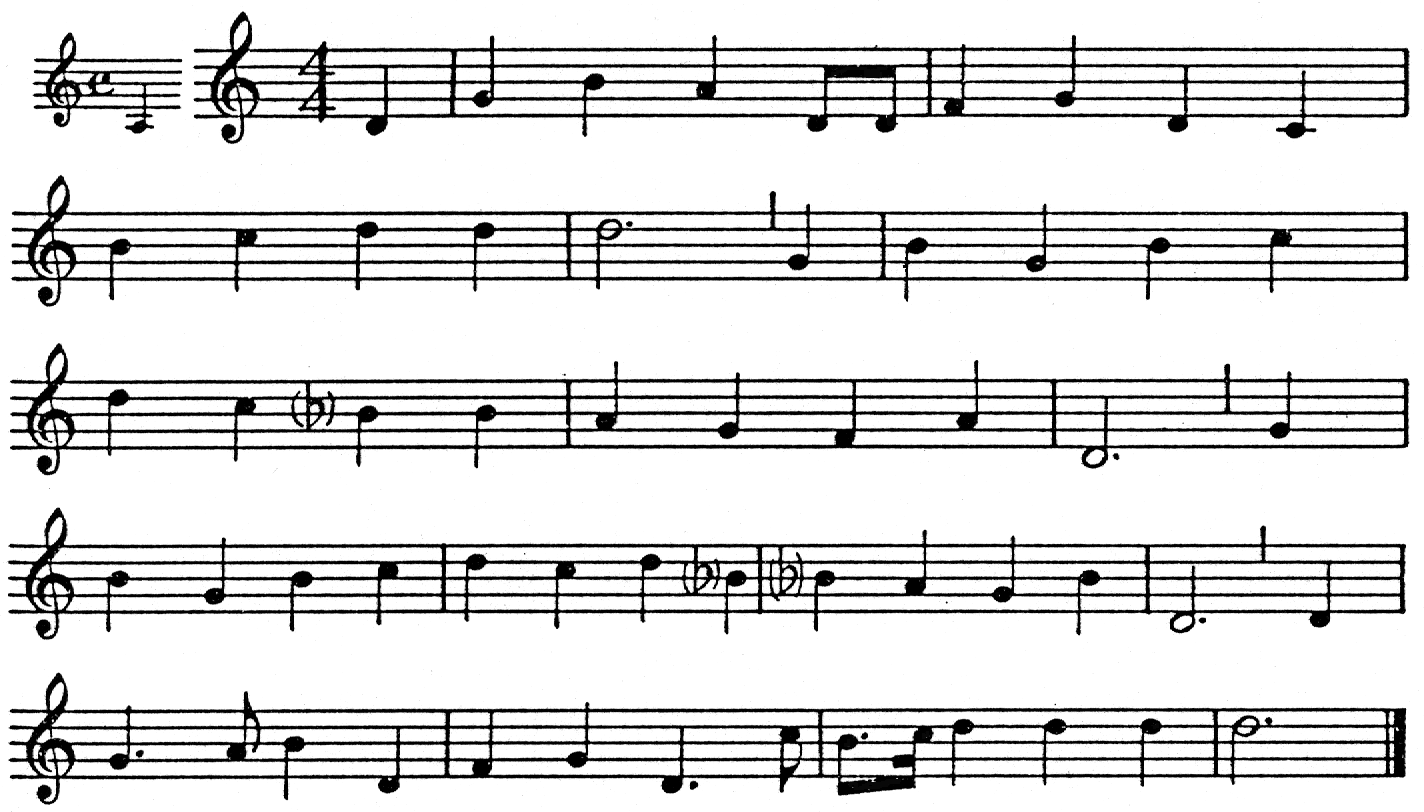
source:The Traditional Tunes of the Child Ballads by Bertrand Harris Bronson. Bronson cites:
Milligan-Fox, JIFSS, I, (1904), p. 47. Sung by Ann Carter, Belfast, 1904; learned from an old woman in Connemara. Recorded by Mrs. Elizabeth Wheeler.
Janet of Carterhaugh
There is no associated text for the tune.

source: The Traditional Tunes of the Child Ballads by Bertrand Harris Bronson. Bronson cites:
Blaikie MS., NL Scotland MS. 1578, no 76, p.24
Notes on the Musical Notation
Musical analysis provided by Andrew Cushen
The first 3 are in the key of F Major/D Minor, and are closely related; the 4th is in G Major/E Minor.In fact, there are but two differences between the first version and the second. The first difference is speed; the second version is played twice as fast. If you read music, the Quarter notes in the first version are Eighth notes in the second, etc. Apart from that, the main melodies are identical. The only other difference is that the second version has a low counter-melody, or "bass line", added to it.
The third version is identical to the main melody line of the second version; it just strips off the low melody "bass line".
So we will look at the first three versions as being the same; as noted, the only differences are speed and the addition of the "bass line" in the second. They are all in the same key. Other than one note which I will discuss shortly, the melody is strictly in the key of F Major, or D Minor (the two keys contain the same notes; D Minor is the "Relative Minor" of F Major, in musical terms). I am going to refer top it as D Minor, as the tune has that sad sense you get from a Minor key.
Examining these 3 versions, the only note that is not in the key of D Minor is the C# note, which appears as the last note of the 3rd full measure in version 1, and as the fourth note of the 2nd full measure in versions 2 and 3.
In the key of D, C# would be the Major-7th note. You do not ordinarily have a Major-7th in a "straight" Minor key - instead you have a Minor-7th, also known as a Dominant 7th. The momentary addition of the Major-7th momentarily changes the key to D Harmonic Minor. The Harmonic Minor scale has an exotic, almost "Eastern" sound. Many folk melodies make use of altered Minor scales like the Harmonic Minor, and other unusual scales like the Church modes, such as the Dorian and Lydian modes; Celtic folk songs in particular make liberal use of these scales. You don't hear the distinct flavoring of the Harmonic Minor scale that strongly in these versions of "Tam Lin" because the Major-7th is played quickly and not emphasized. Notes like this that are played quickly in between two notes that are in key are referred to as "passing tones" or "passing notes", as they are played when passing from one note to another.
Minor keys in general are often used in accompanying a sad or eerie lyric, as they have a correspondingly "sad" or "creepy" feel to them when used skillfully.
The fourth and final version of "Tam Lin" that we will look at here, the fourth song notation from the top of the page, is almost an entirely different melody, though clearly related to the previous three. It is in the key of G Major/E Minor; again, I will refer to it as E Minor. There is no Major-7th in this song; the notes are strictly from the "straight" E Minor scale. As such, there is not much to add here, other than to note in passing that the 6th note of the scale, C, is used only once in the entire melody, whereas the rest of the notes in the scale are used several times each.
Notes
Added to website November 1998, split into separate pages October 2014